
On October 15, 2026 (local time in the U.S.), Tesla demonstrated the second‑generation Roadster at SpaceX's test site in Texas. Using cold‑gas thrusters and an underbody suction system, the electric sports car performed inverted driving, brief hops, mid‑air flips and demonstrated 0–60 miles per hour in approximately 0.81 seconds. Elon Musk said the new car is planned for production beginning in 2028. Meanwhile, Tesla has reopened reservations on its official website.
The demonstration video quickly spread online and drew considerable praise; many regard it as an important step toward a science‑fiction era for the automotive industry. Objectively, the event does expand the imagination of vehicle performance, but judging from engineering maturity, road safety, regulatory certification and scalable production, a spectacular demonstration is a different thing from converting the technology into a reliable, affordable and legally road‑worthy product.
1. The technical breakthrough merits attention, but a demo is not a mature product
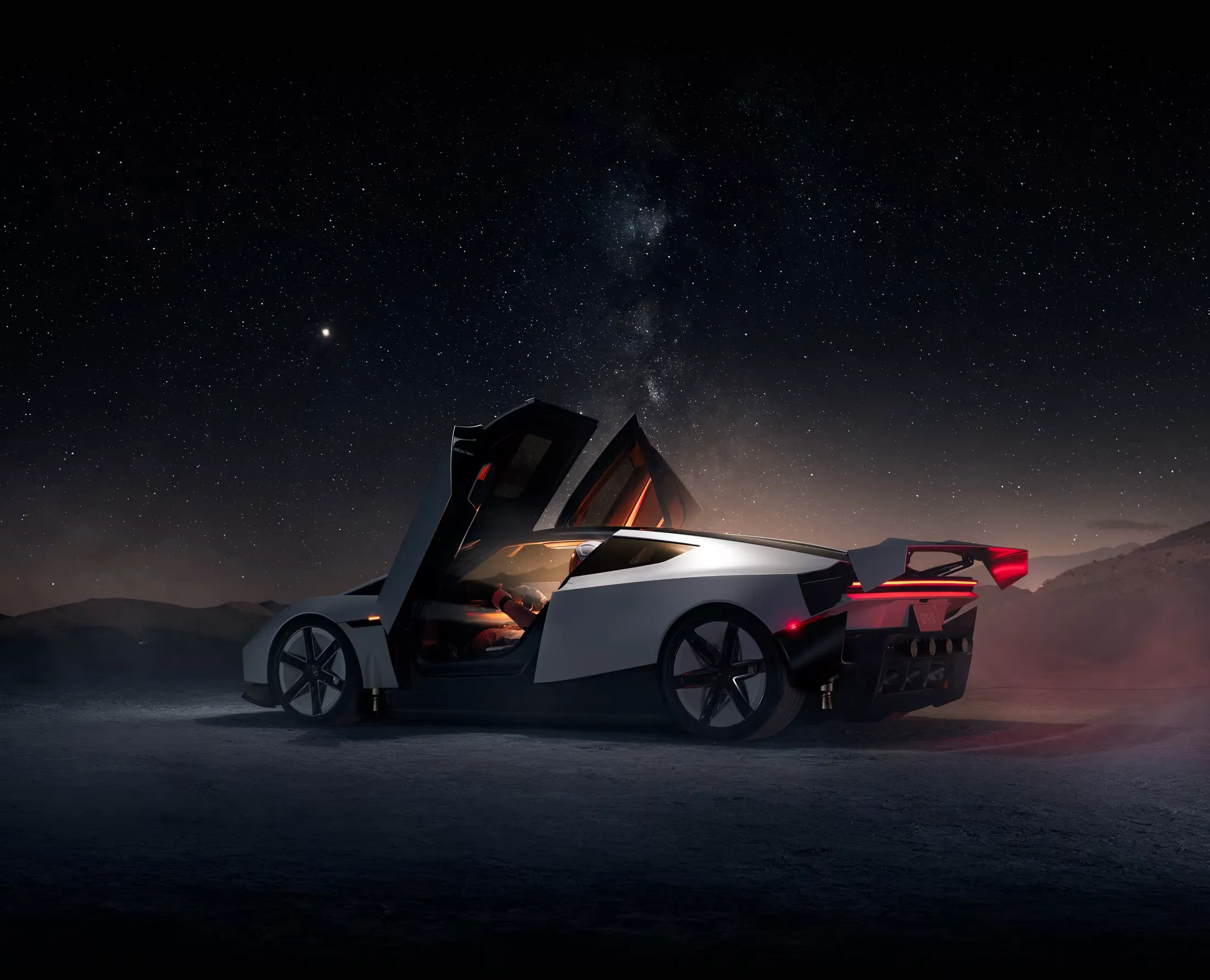
The most striking innovation of the Roadster is the combination of electric vehicle and aerospace propulsion technologies. According to the on‑site demonstration and media reports, the Rocket variant uses about 600 liters of high‑pressure gas storage and multiple directional cold‑gas nozzles, combined with underbody fans that generate suction, enabling short‑duration liftoff and attitude control.
This approach does not violate physical laws. Compressed gas can produce thrust through nozzles, and fan‑generated suction can under certain conditions increase vehicle adherence to the ground. The real challenge is integrating these principles into a stable, safe and repeatable system.
For example, accelerating from rest to 60 miles per hour in about 0.81 seconds corresponds to an average longitudinal acceleration of roughly 3.38 g. Such extreme performance not only requires powerful thrust, it also demands solutions for tire traction, vehicle structural loads, occupant restraints (assuming an occupant mass of 70 kg: the inertial force on the occupant is about 2,318 N, equivalent to the force corresponding to roughly a 236 kg object under normal gravity. This implies occupants would experience very large loads and that seats and seatbelts must provide sufficient support) and emergency braking. A single successful demonstration cannot replace repeated testing, extreme‑condition validation and independent third‑party measurement.
More importantly, the hops shown in the demo do not mean the vehicle already possesses flight capability in the conventional sense. The demonstration shows short‑duration ground‑effect liftoff and attitude control assisted by thrusters, not a complete flying‑car system capable of autonomous takeoff, sustained flight and safely transporting passengers.
2. The real challenges are safety, regulation and reliability
If the Rocket variant is considered an engineering product, its challenges far exceed those of a traditional electric sports car.
First, the high‑pressure gas storage system must withstand crashes, vibration, temperature variation and long‑term cycling. The thrusters, piping and control systems also need fault detection and redundancy. Failure of any critical component could produce thrust imbalance or unpredictable vehicle motion.
Second, extreme performance carries concrete trade‑offs. Storage vessels, nozzles and associated structures take up space and add weight, potentially affecting range, passenger comfort, serviceability and overall vehicle cost. Media reports indicate the Rocket variant sacrifices some practicality (such as removing passenger seats) and has not been authorized for public road use.
Finally, vehicle regulatory certification will not be relaxed simply because the technology is novel. A vehicle must meet applicable requirements for crash protection, braking, handling, safety systems and other regulations. If a product involves brief liftoff, additional issues arise around operating environments, personnel safety and liability. Even if the technology works, that does not mean it is suitable to be offered to consumers for ordinary road use.
3. It is essential to distinguish three product states
A realistic assessment of the Tesla Roadster's commercialization prospects requires first distinguishing three different product states.
The first is the technical demonstration state. The core objective at this stage is to prove that a technology can operate under specific conditions. In this demonstration, the vehicle used a high‑pressure gas propulsion system and related devices to achieve extremely short accelerations and brief liftoff effects, showing technical possibilities beyond traditional electric vehicles. But a successful demo does not mean the technology has passed long‑term reliability verification, nor does it prove the vehicle can consistently reproduce the same performance under diverse environments, loads and continuous use. A demo shows technical potential, not complete production capability.
The second is a deliverable production model. This stage requires the vehicle not only to complete a demo, but also to meet continuous manufacturing, quality consistency, crash safety, thermal management, durability, serviceability and regulatory certification requirements. For a road‑legal Roadster (Performance version), key validations include range, acceleration, braking, handling, everyday usability and final pricing to determine competitiveness. Even if a specific acceleration figure can be achieved, it does not mean every production vehicle will reliably reach the same performance in daily use. Tesla's 2028 production target is a stated goal, but the target date alone does not equal certainty of production readiness.
The third is the Rocket variant with rocket‑like propulsion capability. This version faces challenges clearly greater than the road‑legal variant. High‑pressure gas propulsion must address refilling and storage, thrust control, attitude stability, structural strength, occupant protection and emergency procedures. If a vehicle can briefly lift off, further questions include liftoff height, duration, controllable range, landing method and safety margins across different environments. Even if such capabilities are demonstrated under controlled conditions, that does not mean the vehicle meets aircraft‑level safety, nor that it can lawfully or safely operate on public roads or in open environments. Thus, the Rocket variant is best seen as a high‑risk, high‑difficulty engineering exploration whose maturity should not be conflated with the road‑legal version.
These three states correspond to different commercialization judgments: a technical demo answers "can it work under specific conditions?", a production model answers "can it be delivered reliably, compliantly and at acceptable cost?", and the Rocket variant must answer "can it operate safely and controllably in complex real‑world environments?" Only after the latter two sets of questions are fully validated can large‑scale commercial rollout be discussed.
4. Reservations are open on the official site, but the 2028 production target should be viewed cautiously
The second‑generation Roadster was first announced in 2017 and originally planned for production around 2020, but it has been delayed multiple times. Now Tesla has again stated a production target of 2028. At the same time, Tesla has reopened reservations on its website: the deposit for the Performance version is $50,000, the Thrust version's deposit is reportedly higher (about $250,000), and the Rocket version is marked as "invite only."
Opening reservations indicates the company has formally started locking in potential customers, but it does not mean production conditions are already mature. Achieving small‑batch production of a road‑legal version is an engineering problem distinct from commercializing an extreme‑propulsion variant. Even if deliveries of a certain version begin in 2028, that should not be taken to mean the Rocket variant has mature production readiness, nor that limited initial production equates to large‑scale manufacturing.
To judge whether the project is truly close to deployment, observers should look for final production specifications, independent performance tests, formal certification progress, factory production readiness and a clear delivery plan, rather than relying solely on the visual impact of a reveal event, a website reservation channel or management timelines.
5. The Roadster's significance may lie in exploring boundaries
Despite many uncertainties, the Roadster's technical exploration has value. It places vehicle dynamics, aerospace propulsion, active aerodynamic control and high‑performance electric platforms in the same experimental arena, helping explore extreme acceleration, vehicle attitude control and powertrain design for special scenarios.
However, the value of technological innovation should not be judged only by how spectacular a demo is; it should be assessed by whether it can achieve a balance of reliability, cost, safety and practical utility. Automotive history shows that technologies that truly change the industry usually require not only breakthroughs in performance but also repeated validation, standardized design and scalable manufacturing.
Therefore, this Roadster appearance is better understood as an attention‑grabbing technology demonstration, not proof that the flying‑car era has arrived. An open attitude toward the 2028 production target is reasonable; whether the Rocket variant can become a widely purchasable, legally road‑worthy mature product still requires more substantial engineering and regulatory evidence.
A genuine technological revolution is not only about making machines do previously impossible actions, but also about making them perform those actions safely, reliably and economically on a repeatable basis. The Roadster has opened up the realm of imagination and has begun collecting potential customer interest via website reservations, but a gap remains between a demo and large‑scale deployment that must be closed by engineering verification and actual delivery.
▶️ Enjoyed this article? Creating great content takes effort!
Subscribe to our YouTube channel:
AI Rosetta
Your likes, subscriptions and shares mean the world to us! 🙏
For more AI news, visit:
https://www.airosetta.com