
On Oct 15, 2026 local time, Meta officially released the open‑weight model Muse Spark Open, proclaiming it as the most capable U.S. open‑weight model to date. Launched shortly after the closed flagship Muse Wonder, the model uses a native multimodal architecture with 816 billion total parameters (42 billion activation parameters) and a 1 million‑token context window. It is tuned for code construction and agent collaboration scenarios, showing strong performance on long‑range tasks, complex software engineering, and multi‑step reasoning. The model weights are available on Hugging Face, Amazon SageMaker AI, Google Cloud Model Garden, and Microsoft Foundry Models, and the model is supported by major inference platforms.
Details
Muse Spark Open is built on the earlier Muse Spark series (sharing the same base model as Muse Spark 1.3) and underwent additional safety fine‑tuning to improve robustness when running without system‑level guardrails. Officially, Meta positions it as a "desktop‑class" frontier open model for developers and agent workflows.
Core specifications:
- Architecture: Sparse Mixture of Experts (MoE), 816B total parameters, ~42B activated per token.
- Context: Native support for a 1 million‑token window, capable of containing large codebases, complex dependencies, and thousands of files without splitting tasks.
- Multimodal: Native input support for text, images, audio, and video, with text output; includes a perceptual encoder able to directly interpret screen recordings, video clips, or documents.
- Optimization focus: Long‑range agent tasks, complex software engineering, multi‑step reasoning, and tool use.
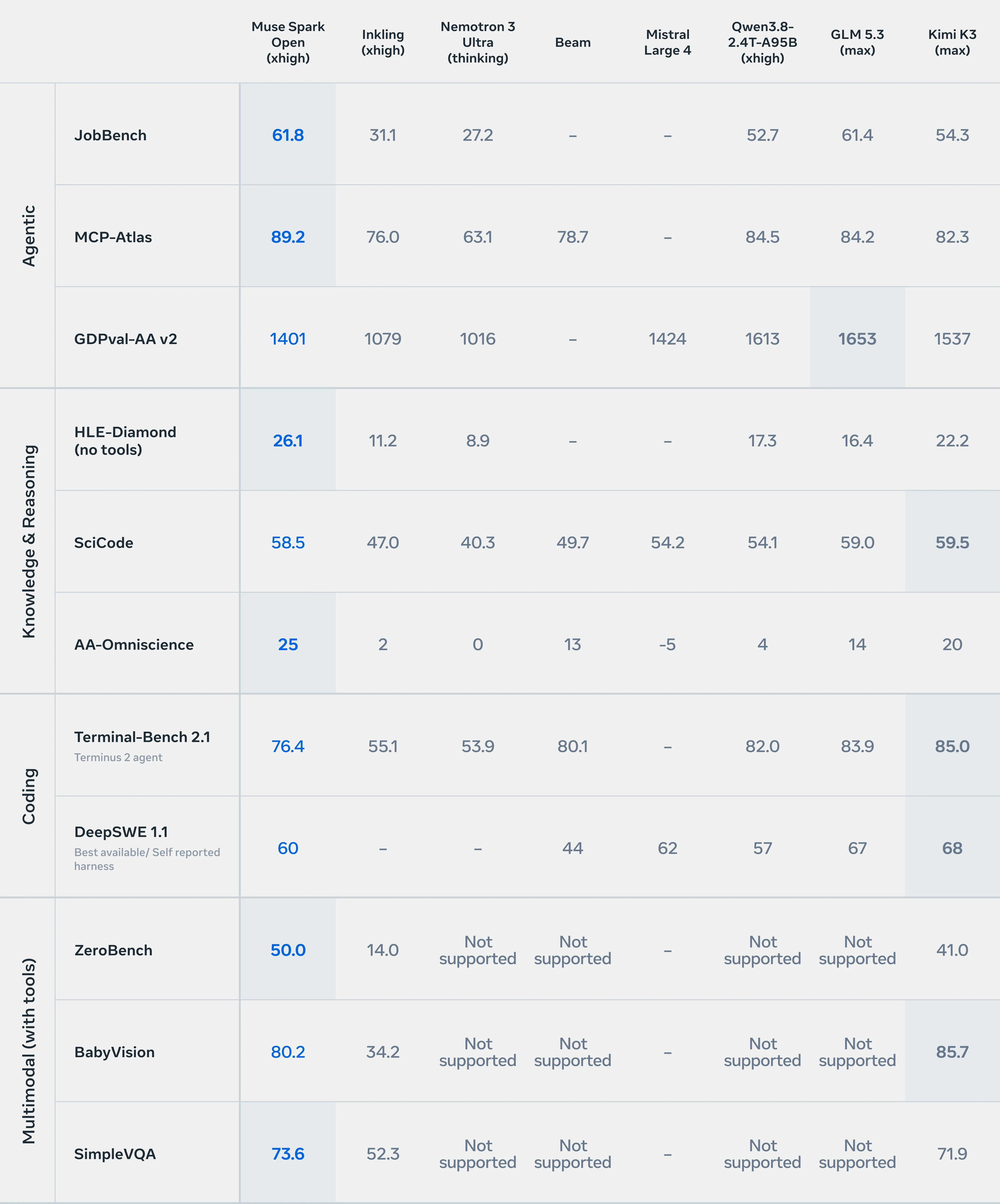
Performance and benchmarks: Meta's published comparisons show Muse Spark Open leading many U.S. and some open‑source models on agent benchmarks such as JobBench and MCP‑Atlas—for example, a JobBench score of 61.8, notably higher than some competitors. It excels in tool usage and multi‑step collaboration. However, on certain pure coding benchmarks (e.g., Terminal‑Bench 2.1) it still lags behind some Chinese open‑source models (such as Kimi K3 and GLM 5.3). Overall, it is positioned as the "strongest representative of the U.S. open‑source camp," rather than as a universal winner across all global open models.
Deployment and ecosystem:
- Supports major inference engines including SGLang, vLLM, TensorRT‑LLM, MLX, and llama.cpp, with optimizations for NVIDIA, AMD, Intel, and Apple silicon.
- In particular, Meta collaborated with Apple to optimize via the latest MLX framework so the model can run locally on two Mac Studio machines equipped with M5 Ultra, offering a "desktop supercomputer" experience. Official demos include end‑to‑end driving of DaVinci Resolve for video editing and submitting complete iOS features and fixes to the open‑source app Ice Cubes.
- Weights are available in BF16 and quantized variants; local runs demand high‑end hardware (NVFP4 quantization requires roughly 700GB+ VRAM, BF16 needs more).
- Available via API through platforms such as Baseten, Fireworks AI, Groq, Modal, Nebius, OpenRouter, and Together AI.
- Supports further fine‑tuning with PyTorch TorchTitan (including multi‑turn SFT, LoRA, and reinforcement learning).
License: Distributed under the Muse Model License, permitting free use, modification, fine‑tuning, distillation, and distribution, with limited commercial terms and no additional fees.
Meta AI chief Alexandr Wang emphasized that this move continues the company’s commitment to open models, while noting that "for safety and capability reasons, we generally will not open‑source our very strongest models"—the closed Muse Wonder therefore remains proprietary.
Potential impacts
1. Strengthening the U.S. open‑source ecosystem
Against a backdrop where Chinese open‑source models (Qwen, Kimi, GLM, etc.) keep leading on some benchmarks, the release of Muse Spark Open provides U.S. developers and enterprises with a stronger locally controllable option, helping reduce reliance on closed APIs and supporting private deployment and data‑sovereignty requirements.
2. Accelerating agent and coding workflows
The 1 million‑token context and native multimodal capabilities make the model more suitable for "whole‑repository understanding + long‑range execution" scenarios, which could speed adoption of internal coding agents, automated software engineering, and multimodal toolchains. Desktop‑level operation (notably on Apple hardware) further lowers experimentation barriers.
3. Clarifying an open‑and‑closed dual strategy
By open‑sourcing powerful models while keeping the very top‑tier capabilities closed, Meta demonstrates a pragmatic approach of "opening the middle layer while controlling the top layer." This aligns with current industry trends and offers a reference for other vendors.
4. Hardware and ecosystem interplay
Deep optimization with Apple MLX and immediate support from AMD and NVIDIA indicate that open models are becoming an important driver of cross‑hardware ecosystem development. At the same time, high hardware requirements mean large‑scale local deployment will remain concentrated among resource‑rich teams.
5. Safety and misuse risks
Additional safety fine‑tuning reduces risks for independent deployments, but open weights inherently carry potential for misuse. The industry must keep monitoring alignment and control effectiveness in real deployments.
6. Implications for developers and small teams
Compared with closed flagship models, open weights offer paths for customization, distillation, and private deployment, which are especially valuable for deep integration or sensitive‑data scenarios. Tools like TorchTitan further lower the barrier for downstream development.
Conclusion
The release of Muse Spark Open marks an important step in Meta's 2026 open‑source strategy. With 816B total parameters, 42B activation, a million‑token context window, and native multimodal capabilities, it sets a new benchmark for U.S. open models and is deeply tuned for coding and agent use cases. Although gaps remain on some pure coding benchmarks, its advances in tool collaboration, long‑range tasks, and desktop‑run capability have practical deployment value.
As weights become fully available and the ecosystem rapidly adopts them, the developer community will quickly validate real‑world capabilities. Going forward, the coordinated evolution of Muse series' open and closed models, together with ongoing competition from Chinese open‑source models, will shape the global AI infrastructure landscape. Meta's move again demonstrates that, in the agent era, open weights remain a key force for broadening access to technology and accelerating innovation.
▶️ Like this article? Creating content is hard work!
Subscribe to our YouTube channel:
AI Rosetta
Your likes, subscriptions, and shares are our greatest support! 🙏
More AI news at:
https://www.airosetta.com