
On October 12, 2026 local time, Meta officially announced on its website the new generation of flagship AI models—Muse Wonder and Muse Wonder Full. This marks Meta's first real entry into the "frontier model" category. The company stated that the two models' performance on reasoning, writing, coding and agent tasks has approached or in some cases surpassed top products from Anthropic and OpenAI, signaling a significant narrowing of the gap with industry leaders in the AI race.
Details
The Muse Wonder series was led by Meta Superintelligence Labs and trained at the company’s gigawatt‑scale Prometheus data center. The models continue the pretraining and reinforcement learning trajectory of the earlier Muse Spark and have been scaled up substantially. Both models support a 1,000,000‑token context window and can process mixed inputs of text, images, video and audio.
Key capability highlights include two agent‑oriented mechanisms:
- Active Memory: can retain and recall user‑relevant information across conversations, maintaining contextual coherence for long‑running tasks.
- Active Focus: when a task is blocked, the model attempts multiple paths, recovers from errors, proactively clarifies and confirms before critical steps, reducing the risk of agents "drifting" off‑task.
Meta emphasized these models are designed for personal and professional agent use cases across complex domains such as law, finance, healthcare and programming—for example, handling insurance claims, interpreting leases, and building runnable applications from scratch.
Benchmark performance (according to Meta's model card and independent evaluator Artificial Analysis):
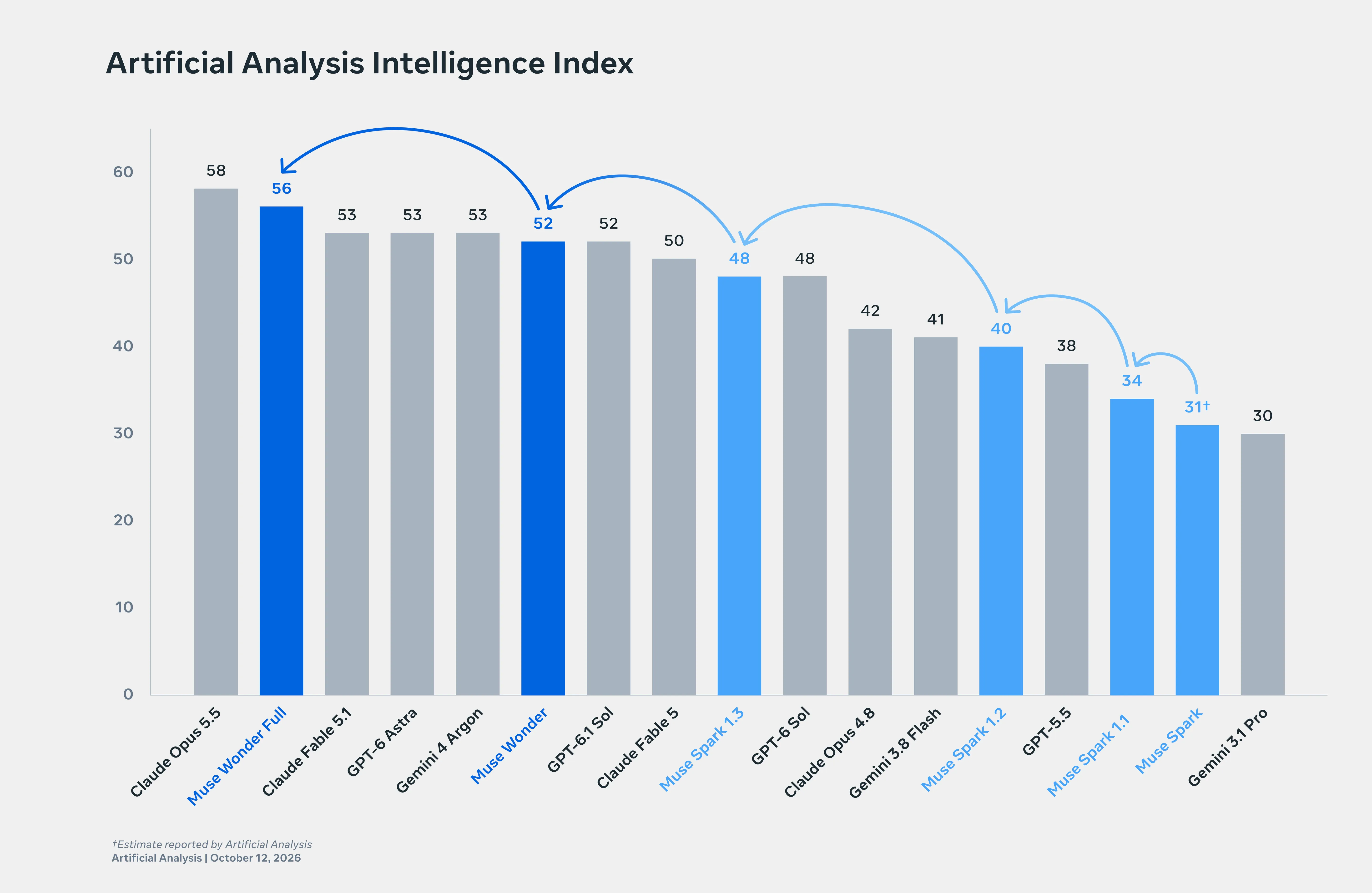
- On the Artificial Analysis Intelligence Index v4.3, Muse Wonder Full scored 56 (highest reasoning intensity), matching Claude Sonnet 5.5 and trailing only Claude Opus 5.5 (58), while outperforming GPT‑6 Astra (53) and Claude Fable 5.1 (53).
- Muse Wonder scored 52, a notable improvement over the previous‑gen Muse Spark 1.3 which scored 48.
- Strong performance on long‑horizon coding tasks: on DeepSWE 1.1 Wonder Full reached 79.0%, and on SWE‑Marathon 57.5% (versus Claude Opus 5.5 at 46.3%).
- Leading or top‑three results on multiple agent‑focused evaluations such as the legal agent benchmark Harvey LAB‑AA and the automation workflow AutomationBench‑AA.
- On memory‑related benchmarks (MemoryBench), the Wonder series also exceeded major competitors.
It should be noted that some coding comparisons were not fully controlled (different models used different scaffolding), and knowledge‑based evaluations remain a comparatively weaker area.
Availability and pricing:
- Muse Wonder: available now via the Meta Model API and Muse Code. API pricing is $4 per million input tokens, $20 per million output tokens, and cached input at $0.20, roughly comparable to GPT‑6 Sol or Claude Opus 5.5.
- Muse Wonder Full: currently available only to Muse Code subscribers (monthly fee around $50–200) and not offered via a public API. Meta plans for Wonder to gradually power personal agent products (Muse), prioritizing subscribers.
Neither model's weights are available for download, continuing Meta's recent shift from open‑source Llama releases toward closed‑source commercialization.
Potential impact
1. Meta re‑enters frontier competition
Previously, Meta held an important position in the open‑source ecosystem with the Llama series—especially Llama 3—but after Llama 4 underperformed expectations the company carried out large AI hiring and reorganizations. Despite that, Meta long trailed OpenAI and Anthropic on closed‑source flagship performance. The Muse Wonder series launch, and Wonder Full's near‑top results on composite indices and agent tasks, mark substantive progress in Meta's "personal superintelligence" strategy and may reshape perceptions of the top‑three landscape.
2. Agents become the new battleground
The Active Memory and Active Focus designs directly address forgetting and drift in long‑horizon, multi‑step tasks. This aligns with the industry's shift from single‑turn dialogue toward persistent agents. If these mechanisms prove effective in real‑world deployments, they could spur other vendors to accelerate similar capabilities.
3. Business model and ecosystem strategy
Meta locks its strongest model (Wonder Full) behind the paid Muse Code programming assistant while making the second‑tier model available via API, reflecting a "product‑first, API‑as‑complement" strategy. This helps convert AI capability into subscription revenue and leverages Meta's large user base (Muse personal agents) for scale. For developers, the API's price‑performance mix offers a new option.
4. Pressure on the competitive landscape
OpenAI and Anthropic face more direct competitive pressure. In particular, Meta's advances in coding agents and specialized professional tasks may push rivals to accelerate iteration or adjust pricing. Rapid follow‑up from independent evaluators also increases industry transparency and reduces reliance on vendor self‑assessments.
5. Risks and watch points
- Whether real‑world performance matches benchmarks needs third‑party and user verification.
- Breadth of knowledge and hallucination control still require improvement.
- The closed‑source strategy may weaken Meta's prior influence in open‑source communities.
- Privacy and data‑use concerns—especially around cross‑conversation memory—will remain in focus.
Conclusion
The launch of Muse Wonder and Muse Wonder Full is an important attempt by Meta to rejoin the first tier in the AI race. It demonstrates the company's accumulated advantages in compute, talent and training methods beginning to translate into measurable frontier performance, and it clarifies an agent‑centered product direction. Although Claude Opus 5.5 still holds a slight edge on composite indices, Meta has shown it can achieve rapid, substantial gains.
In the coming months, the market will closely watch Wonder's performance in real agent workflows, API adoption rates, and Muse product user growth. The AI competition has entered a new phase of "flagship performance plus agent deployment," and Meta's move undeniably intensifies that race.
▶️ Enjoy this article? Creating content is hard work!
Follow our YouTube channel:
AI Rosetta
Your likes, subscriptions and shares are our greatest support! 🙏
For more AI news visit: https://www.airosetta.com