
In mid‑September 2026, an AI model called Jev rapidly gained traction across Silicon Valley and developer communities. It was launched by TypeSafe AI, founded by former OpenAI researcher and InstructGPT co‑author Diogo Almeida. Unlike generative models such as ChatGPT and Claude, Jev is positioned as a "System One" model — it does not write articles, chat, or generate code; it does one thing: quickly produce structured decisions among given options with calibrated probabilities.
Within days of its release, Jev was integrated by major platforms such as Vercel, Cloudflare and LangChain; after its beta opened it attracted many developers and spawned numerous demos, including open‑source projects, browser agents and trading bots. Its rapid rise marks a shift from "being able to speak" to "being able to make reliable decisions."
Core Principle: From Text Generation to Typed Decisions
Jev's design draws directly from Daniel Kahneman's "System 1" and "System 2" distinction in Thinking, Fast and Slow. Large language models resemble the slow, deliberative "System 2", while Jev targets fast, intuitive "System 1" judgments.
It works as follows:
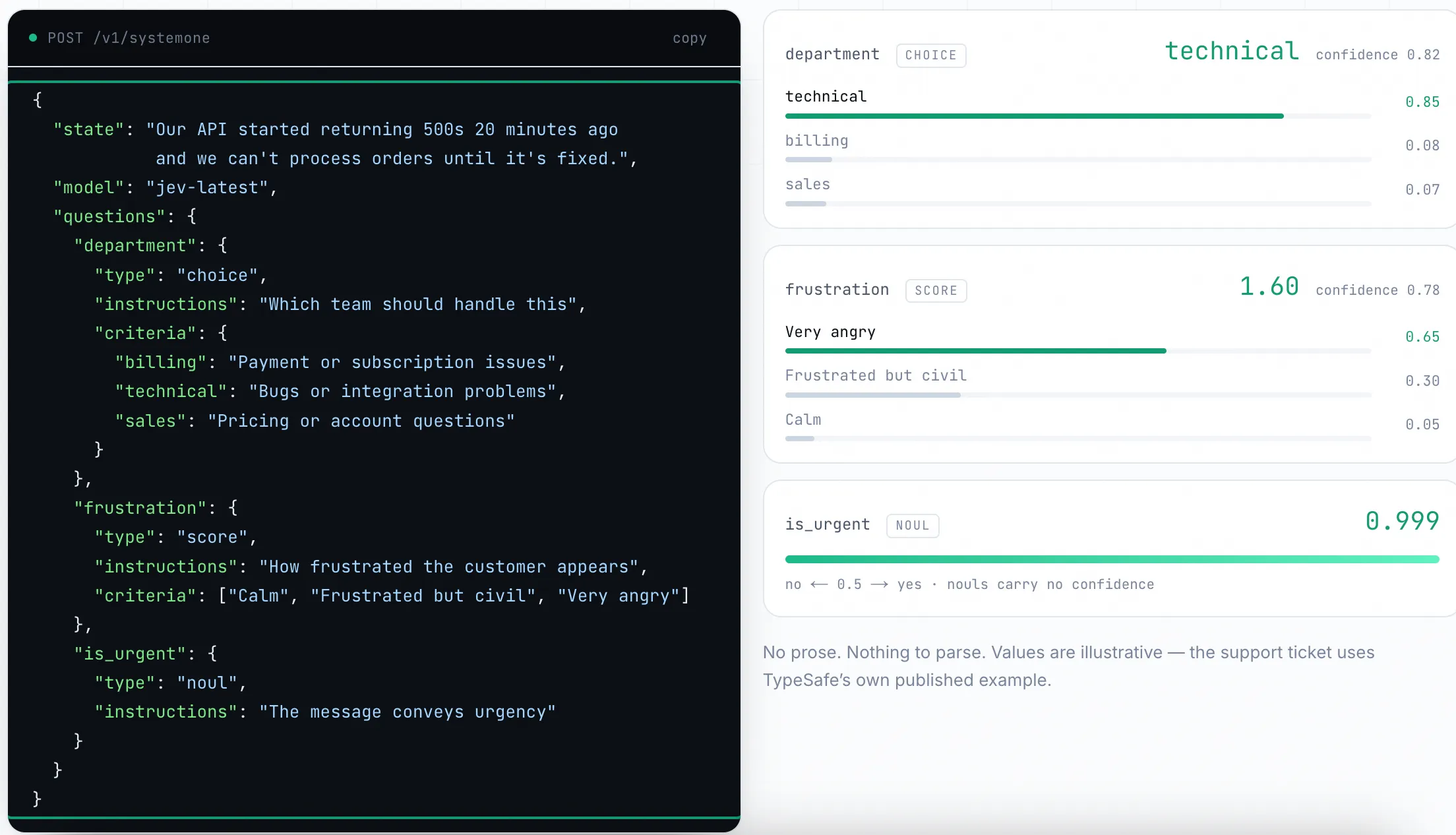
Developers provide the model with an unstructured state input (text, logs, page descriptions, transaction data, etc.) and submit a set of pre‑defined types of questions. There are three primary question types:
- Choice: select one from up to 255 preset options;
- Score: assign a score according to given criteria;
- Noul (or boolean): provide a probability judgment for "yes/no".
The model answers all questions in a single parallel forward pass and returns structured results with calibrated confidences/probabilities rather than generating natural language token by token. Because answers are strictly constrained to the developer‑defined option set, format errors and hallucinations that invent nonexistent options are mechanically eliminated.
For training, TypeSafe uses its in‑house RLCD (Reinforcement Learning for Calibrated Decisions). The optimization objective is not "which answer humans prefer" but "whether probabilities are honest" — if the model says 70%, the true accuracy should be near 70%. This makes output confidences more interpretable and engineering‑friendly.
On performance, the company claims end‑to‑end latency typically ranges from 70–500 ms, far below the seconds‑to‑minutes required by leading large models for similar decision tasks; pricing is about $0.042 per million input tokens with no charge for outputs. Because it does not generate text, its cost structure differs significantly from generative models.
Use Cases: The Agent's "Smart if‑Statements"
Jev is naturally positioned as the decision layer in AI Agent systems, complementing generative large models: the LLMs handle understanding, generation and open‑ended reasoning, while Jev handles routing, filtering, scoring and gating.
Typical scenarios that have already appeared include:
- Agent tool selection and routing: quickly decide which available tool or next action to call and provide confidence to determine whether human intervention is needed.
- Browser and desktop operation agents: after observing page state, decide in parallel which element to click, what to type, whether to scroll, etc., significantly reducing multi‑step interaction latency. Some projects have used it to complete real tasks such as flight searches.
- Code review and quality gating: rapidly classify pull requests or score risk at very low cost, enabling large‑scale automated review.
- Content moderation and safety filtering: judge risk levels among preset categories, suitable for high‑concurrency, low‑latency scenarios.
- Trading and real‑time systems: some developers are hooking it into on‑chain/off‑chain data flows to try high‑frequency decisions. Test results are mixed; public cases show notable losses over short periods, warning that its accuracy is still at an early stage.
- Other: drone obstacle‑avoidance logic, customer support ticket triage, search result ranking assistance, etc.
The community has formed "Jev Engineering" practices: hand generation to LLMs, decisions to Jev, and precise rules to code. This division is seen as helping build more controllable, lower‑cost autonomous systems.
Potential Impact and Challenges
Jev's emergence reinforces a trend: general large models are not necessarily the optimal solution for every problem. In decision stages requiring high frequency, low latency and strong type safety, specialized models may be more efficient. It lowers the cost of "making AI choose among options", freeing developers from brittle prompt engineering and JSON parsing.
For Agent architectures, this may accelerate adoption of a three‑layer pattern: LLM + decision model + deterministic code. For edge devices and real‑time systems, low latency and low cost open new deployment possibilities.
But challenges are equally clear. Jev cannot perform open‑ended reasoning or generate new options; the quality of question design directly determines effectiveness. The reliability of calibrated probabilities needs validation on real business data. Early trading demos showing losses indicate it should not be viewed as a "money printer." Additionally, the model is closed‑source and hosted, so the ecosystem depends on API availability and stable pricing.
Overall, Jev is not intended to replace large models but to fill a long‑neglected gap in the automation stack — fast, quantifiable, type‑safe judgments. Its rapid rise reflects developers' strong demand for AI decisioning that can be embedded in production. As more System One‑style models appear, AI agents may move from "can chat and write code" to "can make stable, low‑cost decisions."
▶️ Enjoy this article? Creating content is hard work!
Follow our YouTube channel:
AI Rosetta
Your likes, subscriptions and shares are our greatest support! 🙏
More AI news at: https://www.airosetta.com