
Contemporary artificial intelligence no longer relies on a single type of processor. As AI workloads have evolved from early simple classification and detection to today’s massive pretraining, long‑context inference, real‑time agent collaboration and on‑device generative applications, compute architectures have shifted from a “one general‑purpose processor to rule them all” approach toward highly specialized heterogeneous computing. Different processors place different emphases on parallelism, energy efficiency, latency, memory bandwidth and programmability, together forming the cornerstone of modern AI infrastructure.
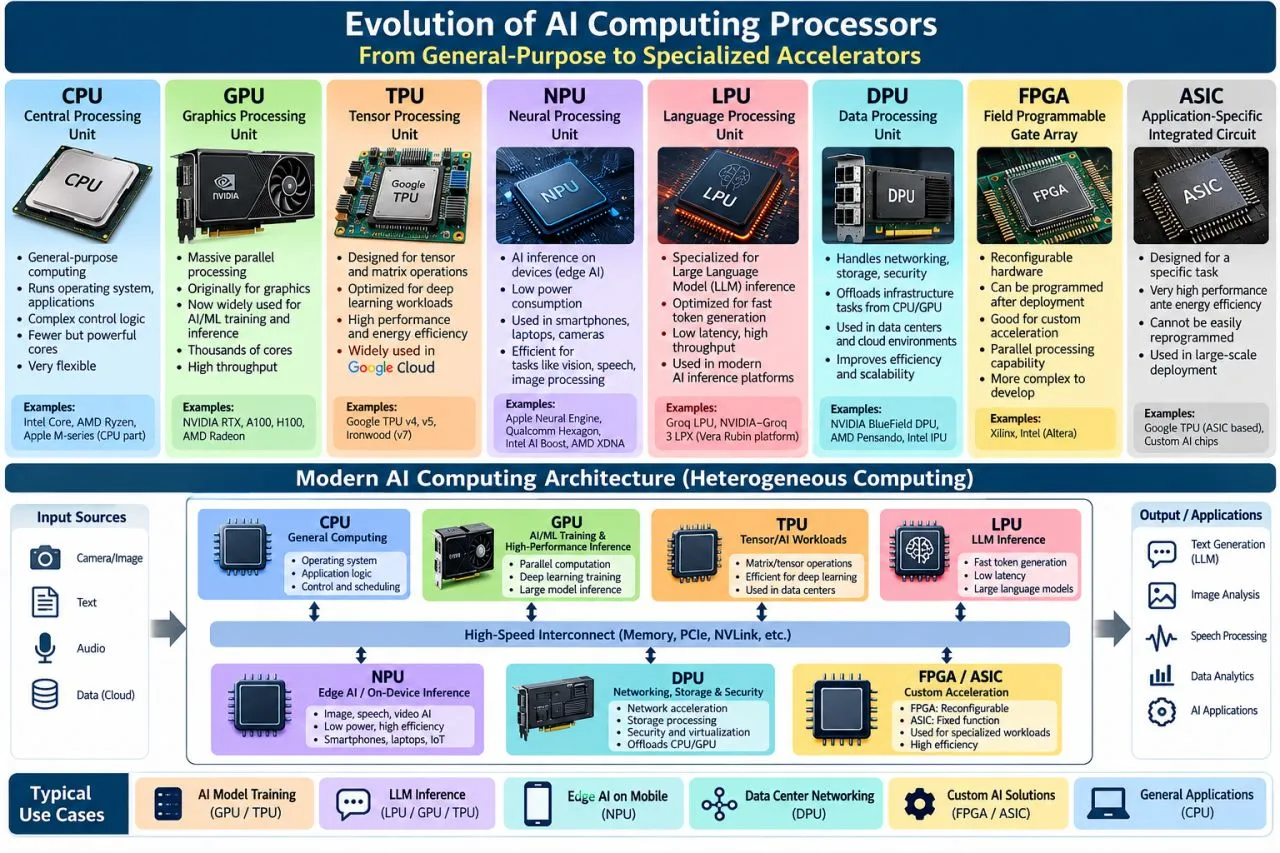
Photo link: https://lnkd.in/p/gNaZfhCc
Below is a detailed analysis of the current core processor types and the global mainstream vendor landscape as of 2026.
CPU: Central Processing Unit — the system’s general control and scheduling core
CPUs are the basic general‑purpose compute units of a computer, designed to efficiently handle complex control flow, branch prediction, out‑of‑order execution and latency‑sensitive single‑thread tasks. They offer strong single‑core performance, a comprehensive cache hierarchy (L1/L2/L3) and a highly flexible instruction set, capable of running operating systems, databases, network stacks, compilers and almost any general‑purpose software.
In AI systems, CPUs seldom perform large‑scale matrix operations directly; instead they act as the “orchestrator”: responsible for model loading and initialization, data preprocessing and postprocessing, task scheduling, coordination in distributed training, and controlling data movement to and from accelerators. Modern server CPUs typically provide dozens to over a hundred cores and support high‑bandwidth memory and PCIe/CXL interconnects to better serve AI workloads.
Major vendors: Intel (Xeon series) and AMD (EPYC series) dominate the x86 server market; Arm architecture, through licensing, is widely adopted — examples include Apple, Qualcomm, Amazon Graviton and Google Axion‑based high‑performance CPUs.
GPU: Graphics Processing Unit — the main engine for large‑scale parallel computing
GPUs were originally designed for real‑time graphics rendering. Their core characteristic is hundreds to thousands of relatively simple compute cores (typically in multiples of 16) using a SIMT (single instruction, multiple threads) execution model, allowing the same operation to be applied to large amounts of data in parallel. This architecture is naturally suited to tensor operations in deep learning such as matrix multiplication and convolution.
Since NVIDIA introduced the CUDA general‑purpose computing platform, GPUs rapidly transformed from graphics cards into core hardware for AI training and inference. Modern AI GPUs further enhance Tensor Cores (dedicated matrix compute units), high‑bandwidth memory (HBM), NVLink/NVSwitch high‑speed interconnects, and optimizations for Transformer models and mixed precision (FP8/FP4). GPUs excel at large‑scale pretraining and, through batching, can achieve high throughput inference. They currently have the most mature ecosystem and software support among AI accelerators.
Major vendors:
- NVIDIA: Holds a dominant position; platforms such as Vera Rubin and Blackwell largely define current training and high‑throughput inference standards, and the CUDA ecosystem creates a strong moat.
- AMD: Instinct MI400/MI455X series, with larger memory capacity and competitive cost‑performance, has been gaining share among hyperscalers; the ROCm ecosystem has matured significantly.
- Others: Intel continues to catch up; Chinese companies such as Muxi and Moore Threads are rapidly following.
TPU: Tensor Processing Unit — an accelerator tailored for deep learning math
TPUs are Google’s custom chips designed for the core computations in neural networks — matrix multiplication and convolution. They adopt a systolic array architecture in which data flows in a regular pattern between compute units, greatly reducing memory accesses and achieving notable advantages in energy efficiency and throughput for specific workloads.
TPUs are tightly integrated with the XLA compiler, enabling efficient mapping of high‑level frameworks like TensorFlow and JAX onto hardware. Newer generations of TPUs (e.g., Ironwood) increase memory capacity, interconnect bandwidth and multi‑chip scaling capabilities, serving Google’s internal large‑scale training and also being offered via Google Cloud. TPUs demonstrate the value of hardware customized to specific mathematical primitives, though their relatively closed software ecosystem means their use remains largely within the Google ecosystem.
Major vendor: Almost monopolized by Google. Other cloud vendors’ custom chips (Amazon Trainium, Microsoft Maia, etc.) follow a similar path but have not yet formed an equally large public ecosystem.
NPU: Neural Processing Unit — an efficient inference engine for edge and endpoint devices
NPUs are optimized for neural network inference, with the core goal of delivering sufficient compute and energy efficiency within strict power and area constraints. They typically integrate many dedicated MAC (multiply‑accumulate) units, hardware support for common activation functions and quantization formats (INT8/INT4), and accelerations for Transformer attention mechanisms.
Unlike GPUs, which pursue maximum throughput, NPUs emphasize performance per watt and low‑latency real‑time response, and are widely integrated into smartphone SoCs, laptops, smart cameras, wearables and automotive chips. They enable local execution of small‑to‑medium sized models and real‑time vision and speech processing, and are a key hardware foundation for on‑device AI growth.
Major vendors:
- Qualcomm (Hexagon NPU): the mainstay of Android flagships, extending to PC and data center inference cards.
- Apple (Neural Engine): deeply vertically integrated, underpinning Apple Intelligence features across devices.
- MediaTek (Dimensity series): emphasizes dual‑NPU designs and always‑on low‑power scenarios.
- Others: Huawei HiSilicon, Samsung, and edge AI specialists such as Hailo and Axelera.
LPU: Language Processing Unit — designed for low‑latency large‑model inference
LPUs are an emerging category tailored to the inference characteristics of large language models (LLMs). The core bottleneck in LLM inference is often not raw compute but memory bandwidth and access latency — generating each token requires repeatedly reading large model weights and KV caches.
Typical LPU designs (Groq is a representative) employ large on‑chip SRAM, deterministic execution pipelines and compiler static scheduling to minimize runtime cache misses and memory contention, achieving extremely low and predictable token‑generation latency. LPUs do not aim for general training capability but instead optimize for “quickly and reliably producing the next token,” giving them unique advantages in real‑time chat, agent responses and similar scenarios.
Major vendors:
- Groq: a principal definitor and promoter of the LPU concept, known for ultra‑low latency.
- Competitors include Cerebras (wafer‑scale engines pursuing extreme throughput) and others using SRAM/dataflow architectures. NVIDIA has also entered the space through acquisitions and integration.
DPU: Data Processing Unit — an offload engine for data‑center infrastructure
As AI clusters scale, networking, storage, security and virtualization overheads increasingly consume CPU resources. DPUs have emerged to offload these “data‑plane” tasks so CPUs and GPUs can focus on compute.
Modern DPUs typically integrate high‑performance network interfaces, cryptographic engines, storage protocol accelerators and programmable data paths, enabling server‑side security isolation, traffic management and KV cache orchestration. In agent systems, DPUs further handle cross‑node context management and efficient data movement, becoming an indispensable “logistics” component of AI infrastructure.
Major vendors: NVIDIA (BlueField series), AMD (Pensando), Intel, Marvell and Broadcom, among others.
FPGA and ASIC: the two ends of flexibility and extreme specialization
FPGAs (field‑programmable gate arrays) provide reconfigurable hardware logic that developers can program to implement custom acceleration circuits. They are suitable for rapid prototyping, small‑volume deployments or scenarios requiring frequent algorithm updates. FPGAs strike a balance between flexibility and performance, but their energy efficiency and peak performance typically fall short of dedicated ASICs.
ASICs (application‑specific integrated circuits) are fully customized for particular workloads, stripping away unnecessary generality to achieve the highest possible energy efficiency, performance density and cost at scale. Most TPUs, NPUs and LPUs are fundamentally forms of ASIC. Increasingly, hyperscalers design custom ASICs to lower long‑term inference costs.
Major vendors:
- FPGA: AMD (Xilinx), Intel (Altera)
- ASIC / custom accelerators: Broadcom, Marvell (providing large‑scale customization for cloud providers), Google, Amazon, Microsoft, Meta, as well as Chinese vendors such as Huawei, Cambricon and Alibaba T‑Head.
Heterogeneous computing has become the new normal
Today’s advanced AI systems are almost always heterogeneous:
- CPUs handle control and scheduling;
- GPUs/TPUs take on training and high‑throughput inference;
- NPUs support low‑power endpoint scenarios;
- LPUs optimize real‑time large‑model services;
- DPUs manage data‑center infrastructure.
This division of labor significantly improves overall efficiency but raises higher demands on software stacks, compilers, runtimes and resource orchestration. The future of competition will shift from “which single chip is strongest” to “how to efficiently orchestrate multiple processor types to form a complete AI compute pipeline.”
Conclusion
From general‑purpose CPUs to highly specialized accelerators, the evolution of AI compute hardware is fundamentally driven by “workloads determining architecture.” As training, inference, edge computing and real‑time generation continue to diverge, a single processor can no longer meet all needs. Understanding each processor’s design philosophy, performance boundaries and major vendor landscape is a prerequisite for building efficient, sustainable AI systems.
True competitiveness lies not in owning the most powerful single chip, but in the ability to flexibly compose the right compute resources for actual workloads and make them cooperate efficiently.
▶️ Enjoyed this article? Creating great content takes effort!
Subscribe to our YouTube channel:
AI Rosetta
Your likes, subscriptions and shares mean the world to us! 🙏
For more AI news, visit:
https://www.airosetta.com