
In November 2025, Bernstein analyst Stacy Rasgon published a report, estimating the “near‑term realistic cost” of building a 1GW AI data center at about $35 billion, significantly below NVIDIA’s then‑forward‑looking $50–60 billion figure. The report used the then‑mainstream GB200/NVL72 architecture as the baseline, estimating about $5.9 million per rack, and noted GPUs accounted for roughly 39% of capital expenditure and annual electricity costs of about $1.3 billion.
Nearly a year later, around October 5, 2026, Bernstein published a systematic update. The latest assessment shows CapEx for building a 1GW AI data center has been revised to $34.6–39.5 billion, depending on the accelerator architecture adopted. Although memory and other component prices surged over the past year, adjustments in overall rack pricing meant the final estimates did not differ much from last year (for example, GB200 rack cost fell from about $5.9 million last year to about $4.13 million this year). Below are the core comparisons between the old and new assessments and the latest conclusions.
I. Comparison Between Old and New Assessments
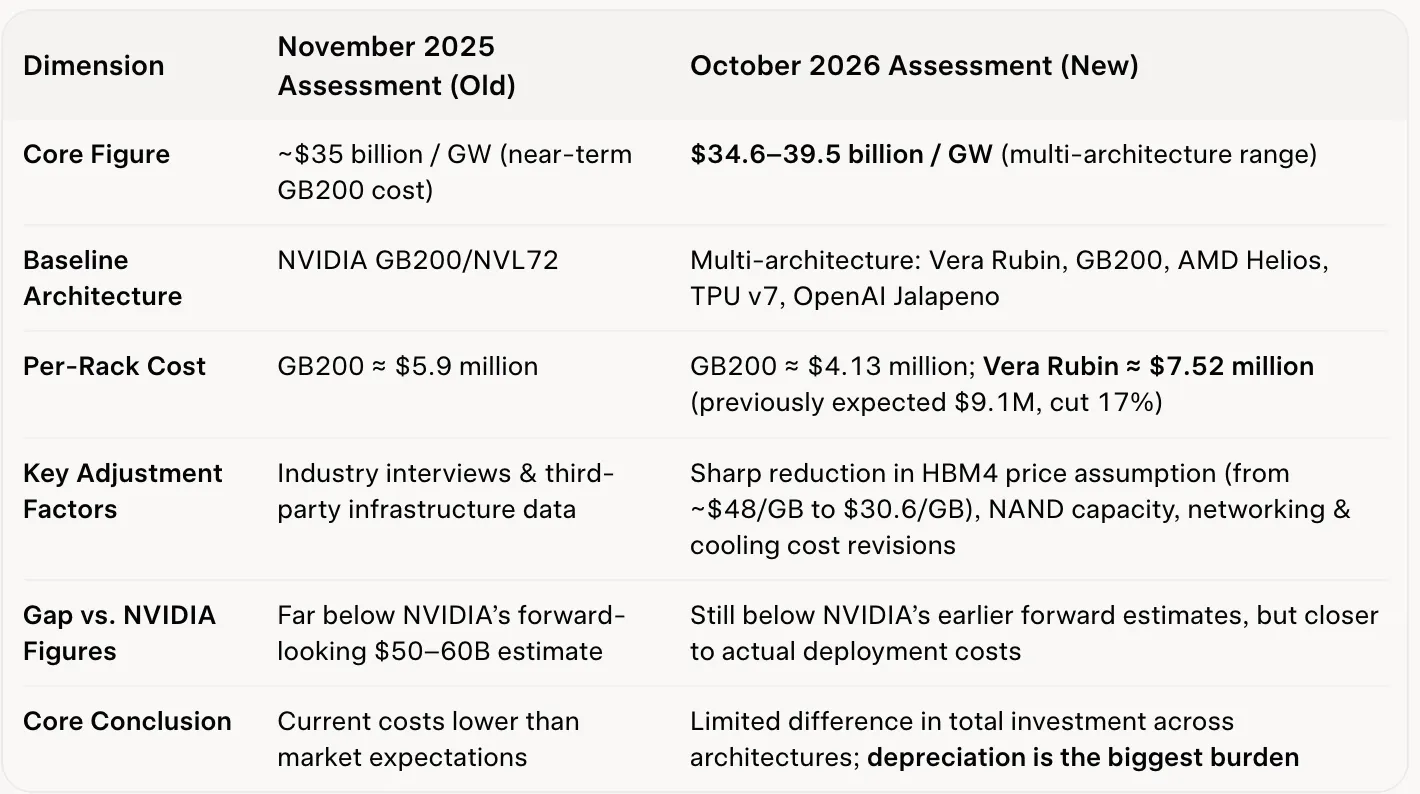
Key changes explained:
- The earlier report focused on the “current realizable cost,” using GB200 to demonstrate that a 1GW deployment need not cost over $50 billion.
- The new report shifts to a multi‑architecture horizontal comparison and incorporates the next‑generation Vera Rubin. Although single‑rack prices were lowered by HBM price declines, the overall 1GW investment still centers around $35 billion and can reach up to $39.5 billion.
- The most important upgraded insight: while per‑system prices vary greatly across chip architectures, when normalized to the same 1GW power the total investment gap narrows to within about $5 billion. The reason is differing power density—systems that are cheaper per unit but have lower power density (such as some TPUs) require more units to reach 1GW, offsetting the per‑unit advantage.
II. Latest Multi‑Architecture Cost Breakdown (October 2026)
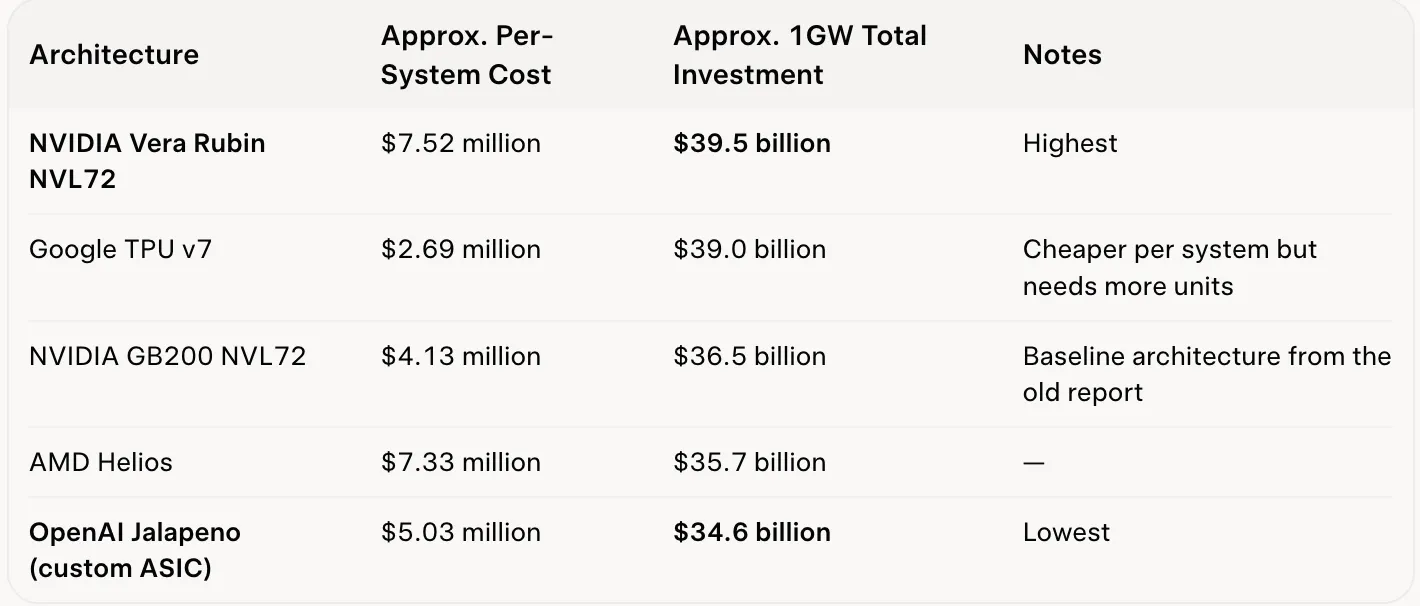
Compute system hardware itself accounts for the majority, but fixed costs such as power delivery, liquid cooling, land and buildings remain on the order of about $12 billion per GW and are hard to significantly compress.
- Annual electricity cost (at $0.15/kWh) remains about $1.3 billion.
- With a Rubin architecture investment of $39.5 billion and a 6‑year depreciation schedule, annual depreciation is about $6.6 billion, roughly five times the electricity cost. Bernstein explicitly states: depreciation, not electricity, is the heaviest economic burden for AI data centers.
III. Summary and Impact
- The cost center remains basically around $35 billion.
- From 2025’s “about $35B” to 2026’s “$34.6–39.5B,” Bernstein’s assessment has not shown a large jump. Price declines in key components such as HBM have offset upgrades from next‑generation architectures, keeping 1GW investment controllable.
- Architectural differences are leveled by “power density”.
- Markets often focus on per‑rack or per‑chip prices, but what truly determines total 1GW investment is “how many systems are needed to reach the same power.” This explains why TPU racks can be cheaper per unit while total 1GW investment approaches that of Rubin.
- Depreciation becomes the core financial variable.
- Annual depreciation from large CapEx far exceeds operating electricity costs, directly affecting cloud providers’ and AI companies’ income statements and payback periods. Differences in depreciation policy (4–6 years) will materially affect companies’ financial performance.
- Implications for the industry
- For investors: the real threshold for 1GW‑scale projects remains around $35 billion—an extremely high capital barrier, but not as unreachable as NVIDIA’s early suggestions.
- For vendors: self‑developed ASICs (such as OpenAI Jalapeno) have some advantage in total cost, but the gap is limited.
- For the supply chain: HBM price volatility has a major impact on overall CapEx and will remain a key variable.
Overall, Bernstein’s two assessments form a clear evolution: 2025 demonstrated “current cost about $35B,” and 2026 further refines this to “$34.6–39.5B across architectures, with depreciation as the true pressure.” This range has become an important market benchmark for discussions on AI infrastructure investment.
▶️ Enjoyed this article? Creating great content takes effort!
Subscribe to our YouTube channel:
AI Rosetta
Your likes, subscriptions and shares mean the world to us! 🙏
For more AI news, visit:
https://www.airosetta.com