
On October 13, 2026, Anthropic published a long post on its official engineering blog detailing that the company had successfully migrated its large monolithic code repository (monorepo) from Git to its self‑developed version control system Scion. The system was designed, implemented and fully migrated by a development team of only seven people in about five months, and was launched alongside complementary tools including the code review tool Antique, code search and an access control system. The direct driver of the migration was an explosive increase in code merges caused by AI agents—daily merge counts rose from around 2,500 in May 2026 to more than 30,000 in September.
Details
Anthropic noted that as models like Claude can autonomously iterate research cycles, micro‑optimize complex programs and build services from scratch, coding itself is no longer the bottleneck; the real constraint becomes developer infrastructure designed for "human scale": source control, build systems and CI.
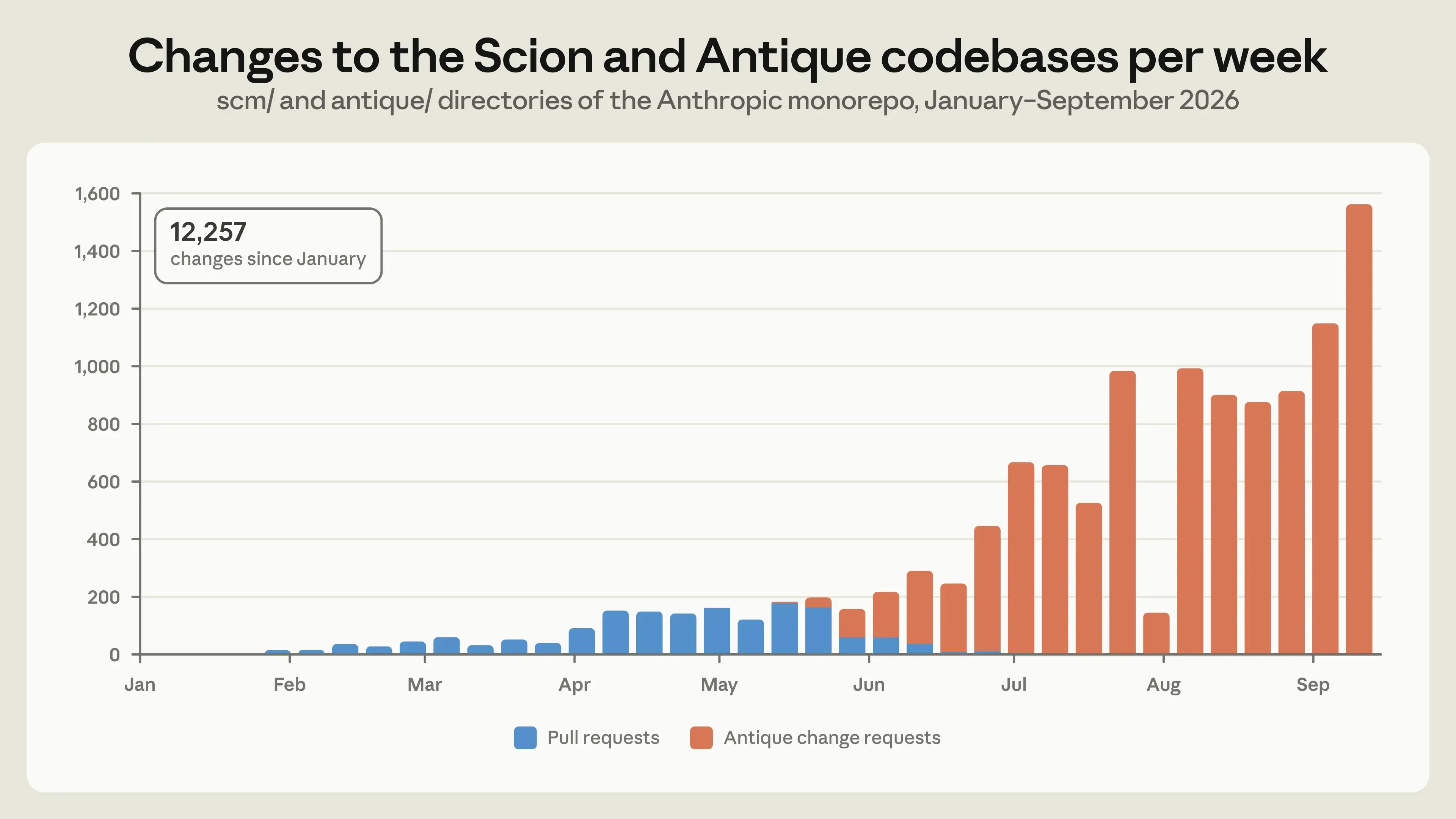
Merged changes to the Scion and Antique codebases per week, from January to September 2026.
The specific scale figures are striking:
- The main branch history approaches 100 GB, and compressed working copies exceed 25 GB.
- The CI system alone performs about 25 million checkouts per day; if full retrieval were done via traditional Git, daily traffic would exceed 600 PB.
- The company previously relied on hundreds of internal Git mirrors, partial clones and snapshots as stopgaps, but with a 12‑fold increase in merges these solutions became unsustainable.
Scion's core design principles contrast sharply with Git:
- Always‑online assumption: Git is distributed and supports offline full clones; Scion assumes clients (primarily AI agents and CI tasks) are always online and lets a server authority handle history queries, blame, merges, rebases and commit creation.
- Fine‑grained objects and incrementality: Changes are recorded as "changesets", storing only the modified files relative to parent nodes and content‑addressed compressed blobs; clients retain a small local cache and fetch on demand.
- Virtualized checkouts: Many tasks do not require a full checkout and can obtain diffs or specific files directly via API.
- Scion draws on experiences from large‑scale systems like Google Piper and Meta Sapling but is optimized for the high‑frequency, fine‑grained changes produced by AI agents.
The migration produced significant results:
- Infrastructure CPU and memory usage dropped to about 1/200 of the previous Git mirror‑based solution.
- Checkout times for CI and research tasks fell from minutes to seconds (roughly two orders of magnitude improvement).
- The CI system freed approximately 25% of CPU capacity.
- Cache hit rates at all layers exceed 99%.
Notably, Claude itself played an important role in development. The team had Claude rewrite the Git‑to‑Scion data import pipeline; without extra instructions it produced a version with 20x lower memory usage and 4x faster performance.
Scion is currently for internal Anthropic use only. The company made clear it will not open source or offer it externally, emphasizing the system targets ultra‑large scenarios such as "tens of thousands of engineers or agent clusters" and is unnecessary for ordinary projects.
Possible implications
1. Revealing new bottlenecks in AI‑era developer infrastructure
When AI greatly reduces the cost and time of "writing code," downstream systems like version control, CI and code review can rapidly become the new constraints. Anthropic's case shows tools designed for humans may systematically fail at agent scale, which could prompt more companies to reassess their toolchains.
2. Driving a trend toward server‑centralized version control
Scion abandons Git's full local clone model in favor of an authoritative server plus lightweight clients. This approach aligns with internal practices at Google and Meta and may accelerate industry discussion and investment in tools for very large monorepos. For small and medium teams, the lesson is to "optimize on demand" rather than blindly build in‑house solutions.
3. Demonstrating AI‑assisted infrastructure development
A seven‑person team delivering such a complex system in five months with substantial help from Claude is a vivid example of AI improving engineering productivity. It suggests future infrastructure teams could be smaller and iterate faster.
4. Indirect effects on open source ecosystems and the tools market
Although Scion itself is closed, its公開 design ideas and problem descriptions may spur open source communities and commercial vendors to improve existing tools (for example, more efficient sparse checkouts, virtual file systems and agent‑friendly APIs). At the same time, organizations embracing AI‑powered coding should plan infrastructure upgrades in parallel.
5. Risks and boundaries
Building a custom version control system entails high long‑term maintenance costs and migration risk; Anthropic's success depends heavily on its unique scale and AI capabilities. For most organizations, continuing to optimize Git (sparse checkout, partial clone, better mirroring strategies) remains the more pragmatic choice. Server centralization can also introduce single points of failure and network dependencies.
Conclusion
Anthropic's Scion project is a typical example of development toolchains forced to evolve after an explosion in AI coding capability. The figures—"7 people, 5 months, 12x increase in merges, 200x infrastructure reduction"—clearly illustrate the limits of traditional Git architectures when agents become the primary code producers. Although Scion will not become a general replacement, the underlying question—how to build infrastructure that matches "near‑unbounded code output"—is one the industry must confront.
As more companies reach similar scale, we may see more customized version control systems, deeper agent‑tool collaboration, and new practices around "AI‑native development pipelines." Anthropic's disclosure provides valuable early reference for that evolution.
▶️ Enjoy this article? Creating takes a lot of work!
Follow our YouTube channel:
AI Rosetta
Your likes, subscriptions and shares are our greatest support! 🙏
More AI news at: https://www.airosetta.com